The Difference Between a Well-Behaved Dog and a Happy Dog
Why good behavior is only one part of a dog’s well-being.
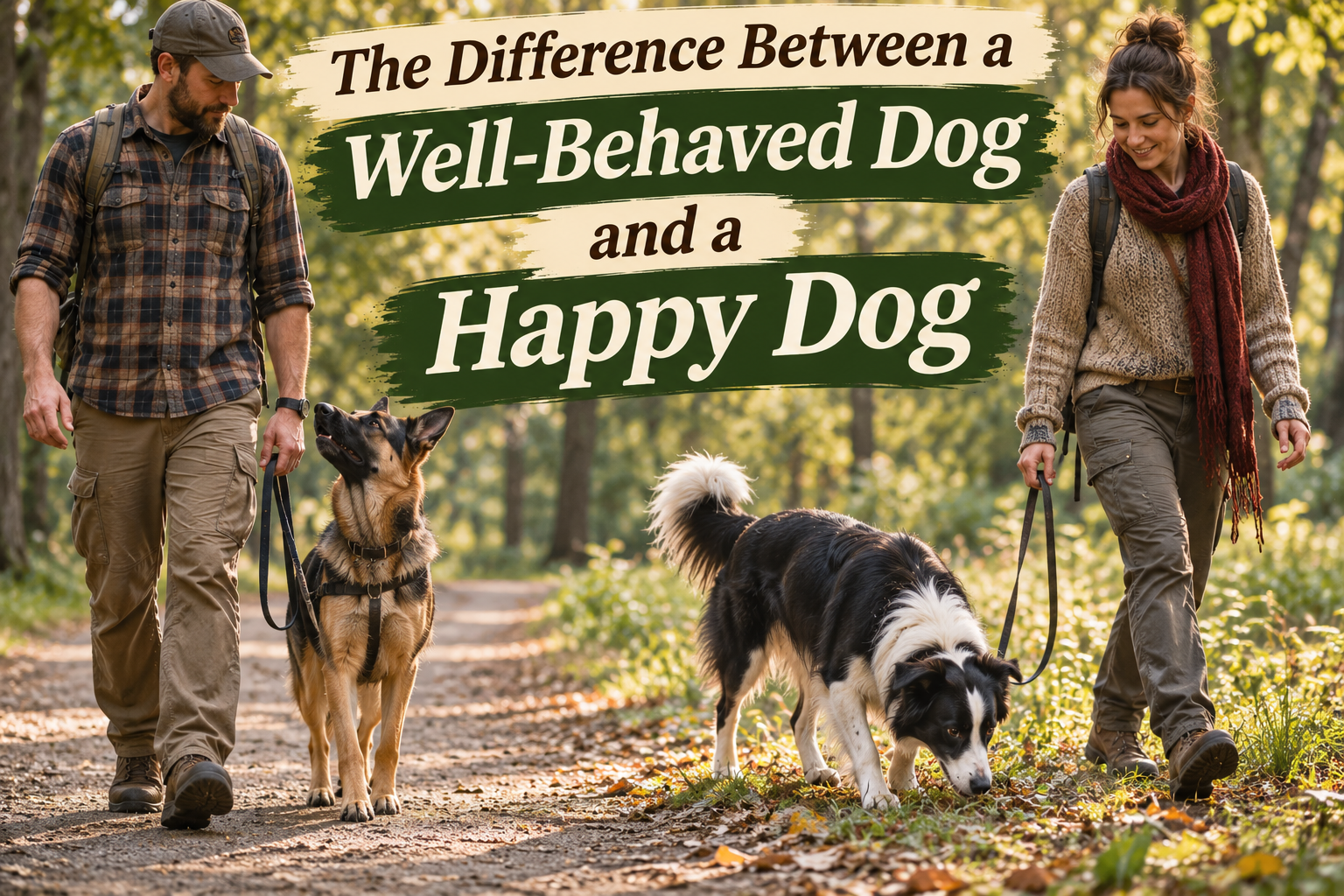
Imagine two dogs walking through a park.
The first walks quietly beside its owner. It doesn’t pull, bark, jump, or stop to investigate anything. It follows every instruction.
The second occasionally stops to sniff, looks around, and shows interest in the world. Its owner allows some exploration while maintaining a loose leash and appropriate boundaries.
Which dog is better behaved?
Which dog is happier?
The answers aren’t necessarily the same.
And that’s worth thinking about.
What Does “Well-Behaved” Actually Mean?
When we describe a dog as well-behaved, we’re usually talking about how conveniently that dog fits into human expectations.
They don’t jump on guests.
They don’t bark excessively.
They don’t pull on the leash.
They come when called.
They remain quiet when we’re busy.
These are useful skills, and teaching them can make life safer and more enjoyable for dogs and their owners.
But there’s something important to recognize.
Being well-behaved describes what a dog does. It doesn’t necessarily tell us how that dog feels.
A dog might sit quietly because they’re comfortable and relaxed.
Another might sit quietly because they’re frightened of what will happen if they move.
The outward behavior could look similar, but the emotional experiences are very different.
That’s why behavior alone, without context, can give us an incomplete picture.
Happiness Is More Than the Absence of Problems
We sometimes evaluate a dog’s quality of life by the problems they don’t cause.
They aren’t destructive.
They aren’t noisy.
They aren’t difficult to manage.
But the absence of unwanted behavior doesn’t automatically mean a dog has a fulfilling life.
Dogs have needs that go beyond food, water, shelter, and obedience training.
They need appropriate opportunities for physical activity, exploration, rest, social interaction, and species-typical behavior.
Exactly what those opportunities look like depends on the individual dog.
A scent hound may find tremendous satisfaction in following an interesting smell.
A retriever may enjoy carrying objects and participating in cooperative activities.
A livestock guardian may be particularly attentive to the environment and the movement of animals or people around it.
And a companion dog may simply enjoy spending quiet time near its family.
These tendencies don’t determine every individual’s preferences, but they can help us understand what kinds of activities may be meaningful to them.
A good life for a dog isn’t simply a life without behavioral problems. It’s a life with opportunities to engage in rewarding experiences.
When Normal Dog Behavior Becomes a Human Problem
Consider some behaviors that frequently frustrate owners.
Digging.
Barking.
Chasing.
Sniffing.
Chewing.
Jumping.
Many of these behaviors are perfectly normal for dogs.
The problem often isn’t that the behavior is unnatural. It’s that the behavior occurs in a place, at a time, or in a way that conflicts with human expectations.
A dog digging holes in a carefully maintained garden can create a genuine problem.
But digging itself isn’t evidence of a defective dog.
A dog who barks at unfamiliar sounds may be responding to something meaningful in its environment.
But persistent barking in a neighborhood can become difficult for everyone.
Training helps us manage these conflicts.
And understanding helps us avoid treating every inconvenient behavior as something that must be eliminated entirely.
Sometimes the better solution is to provide an appropriate outlet.
A designated digging area.
A structured game of chase.
A sniffing walk.
A suitable chew.
We can teach boundaries while still recognizing the underlying motivation.
Choice Matters
Think about how much control we have over our dogs’ lives.
We decide when they eat.
When they go outside.
Where they walk.
Who they meet.
When they play.
And often when they’re expected to remain quiet.
Some of that control is necessary. Dogs depend on us to provide safety, structure, and care.
But opportunities for choice can also contribute to animal welfare.
A dog who can choose between resting places, investigate safe areas, or decide whether to approach someone may experience greater control over its environment.
This doesn’t mean giving dogs unlimited freedom.
A dog shouldn’t be allowed to run into traffic simply because it wants to explore.
Nor should a dog be permitted to frighten other animals or people.
The goal is meaningful choice within appropriate boundaries.
That might mean letting your dog select which direction to explore during part of a walk.
Allowing them to move away when they don’t want affection.
Providing several appropriate enrichment activities.
Or giving them a quiet resting place where they won’t be disturbed.
Small choices can matter.
A Quiet Dog Isn’t Always a Comfortable Dog
One of the challenges in evaluating canine welfare is that dogs don’t communicate their emotional experiences through words.
We have to observe behavior, body language, and context.
A dog lying still might be resting peacefully.
Or it might be overwhelmed.
A dog avoiding interaction might simply prefer solitude.
Or it might be frightened.
A dog who enthusiastically greets everyone might be socially confident.
Or it might be highly aroused and struggling to regulate its excitement.
No single behavior tells the entire story.
We need to look for patterns.
Does the dog appear relaxed?
Do they voluntarily engage with their environment?
Can they recover after something stressful?
Do they have opportunities to rest?
Are they able to express normal behaviors in appropriate ways?
Understanding a dog’s welfare requires more than counting how often they obey commands.
It requires paying attention to the animal’s experience.
Good Training Should Support Welfare
This doesn’t mean obedience and happiness are competing goals.
In fact, thoughtful training can improve a dog’s quality of life.
A reliable recall can provide more opportunities for safe exploration.
Comfortable leash walking can make outings more enjoyable.
Learning to settle can help a dog relax in everyday environments.
Cooperative care training can make grooming and veterinary handling less stressful.
And teaching a dog how to navigate unfamiliar situations can support confidence.
The important question isn’t whether we’re teaching obedience. It’s how and why we’re teaching it.
Are we helping the dog develop useful skills?
Are we considering their emotional state?
Are we providing appropriate outlets for natural behavior?
Are we setting realistic expectations?
Are we creating opportunities for the dog to succeed?
Training and welfare work best when they’re considered together.
Every Dog Is an Individual
Two dogs of the same breed may have very different preferences.
One may love meeting unfamiliar people.
Another may prefer a small circle of familiar companions.
One may enjoy vigorous activity.
Another may be happiest with leisurely walks and quiet enrichment.
Age, health, temperament, experience, and environment all influence what an individual dog needs.
That’s why there isn’t a single formula for a happy dog.
We can learn from breed history and behavioral science, but we still need to observe the individual animal.
Sometimes that means adjusting our training methods.
Sometimes it means changing the environment.
And sometimes it means reconsidering what we expect from our dogs in the first place.
A Better Measure of Success
Instead of asking only whether our dog is well-behaved, perhaps we should ask a few additional questions.
Does my dog feel safe?
Do they have opportunities to engage in activities they enjoy?
Can they rest comfortably?
Are their physical and social needs being met?
Do they have appropriate choices?
And are the skills we’re teaching making their life better, as well as ours?
These questions don’t replace obedience training.
They give it a larger purpose.
Because a dog who behaves perfectly isn’t necessarily a dog who is thriving.
And a dog who occasionally makes inconvenient choices isn’t necessarily unhappy or poorly cared for.
The goal isn’t to choose between a well-behaved dog and a happy dog.
It’s to help our dogs become capable, confident companions while giving them lives worth enjoying.
Bark to Basics Dog Training
Helping people understand what their dog has been saying all along.