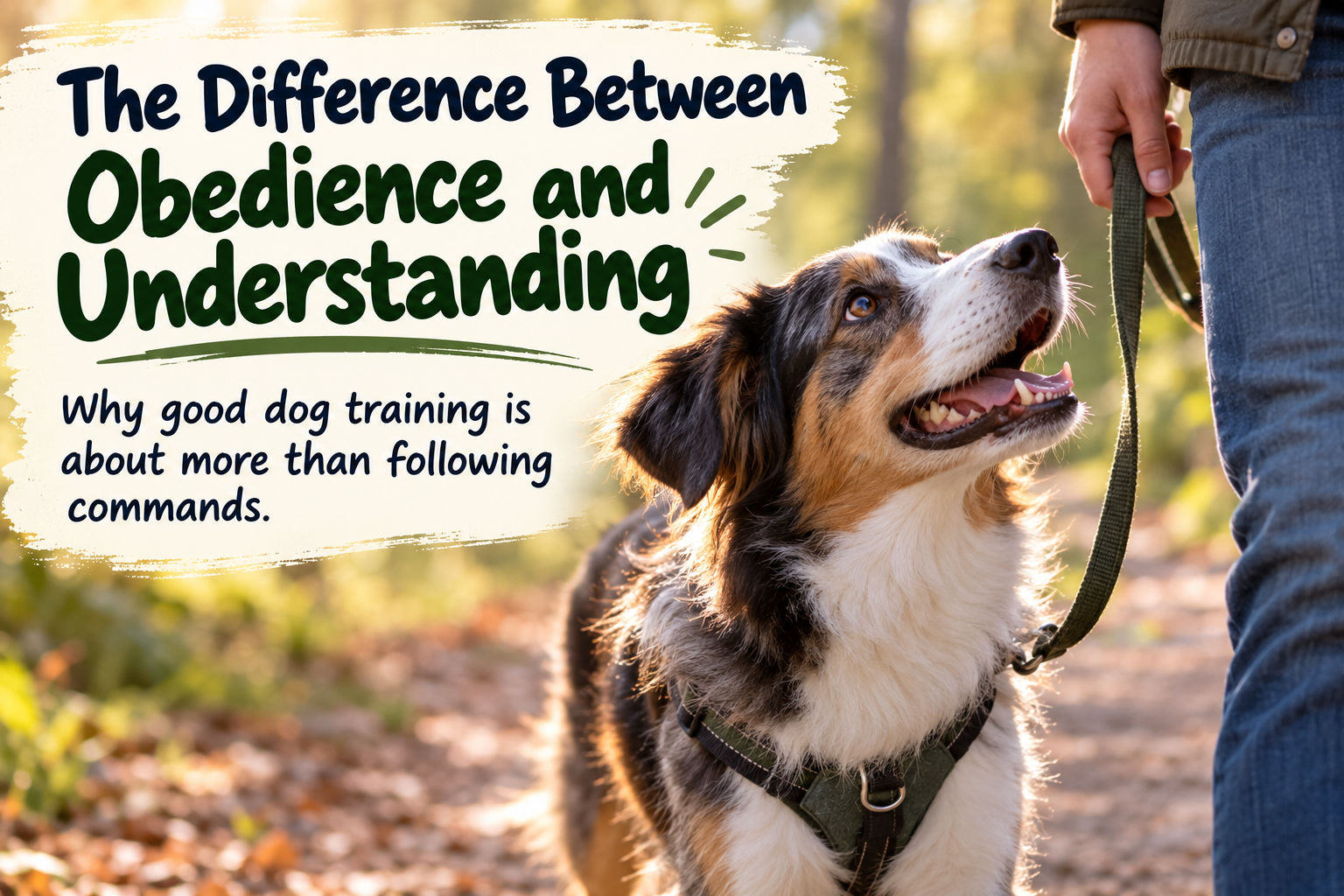
The Difference Between Obedience and Understanding
Why good dog training is about more than following commands
A dog sits when asked. Comes when called. Walks beside their owner without pulling.
We often look at these behaviors and say, “That’s a well-trained dog.”
And perhaps they are.
But here’s a question worth considering:
Does a dog following instructions necessarily mean that dog and their owner understand each other?
Not always.
Obedience and understanding aren’t opposites. In fact, they work best together. But they aren’t quite the same thing, either.
What Obedience Actually Tells Us
When a dog reliably responds to a cue, it tells us something important: the dog has learned a behavior and recognizes when performing it is likely to produce a particular outcome.
That’s valuable.
A reliable recall can keep a dog safe. A solid stay can prevent an accident. Walking politely on a leash makes everyday life more enjoyable for everyone.
There’s nothing wrong with teaching these skills.
The problem begins when we treat obedience as the entire measure of a successful relationship.
A dog can learn to follow instructions without having their needs adequately met. Likewise, a dog can have a wonderful relationship with their owner and still struggle with certain trained behaviors.
Obedience tells us what a dog has learned to do. It doesn’t tell us everything about what that dog is experiencing.
Behavior Is Communication
Dogs communicate constantly, although not always in ways we immediately recognize.
A dog who pulls toward another dog may be excited, frustrated, worried, or simply motivated to investigate.
A dog who refuses to approach something unfamiliar may be frightened rather than stubborn.
A dog who repeatedly interrupts their owner may be seeking attention, struggling with frustration, or expressing an unmet need.
The behavior is something we can observe. Understanding the motivation requires looking at the circumstances.
Consider a dog who won’t sit when asked at a busy park.
An obedience-focused response might be to repeat the command more firmly.
An understanding-focused response asks a different set of questions:
- Does the dog actually know this cue in this environment?
- Are the distractions too difficult?
- Is the dog uncomfortable or overwhelmed?
- Is something else more rewarding at that moment?
- Could sitting be physically uncomfortable?
These questions don’t mean we abandon the training goal.
They help us identify what the dog needs in order to succeed.
Cooperation Is More Than Compliance
Imagine two dogs walking beside their owners.
Both remain close. Neither pulls on the leash.
From a distance, the behavior looks identical.
But one dog walks comfortably, occasionally checking in with their owner, relaxed and interested in the surroundings.
The other walks stiffly, avoiding exploration and showing signs of discomfort.
If we judge only the outward behavior, we might call both walks equally successful.
But are they?
The experience matters.
Good training should help dogs learn useful skills while also supporting their confidence, welfare, and ability to navigate the world.
That doesn’t mean dogs should always get to do whatever they want. Boundaries are necessary, and sometimes safety requires us to interrupt a behavior immediately.
But there’s a difference between establishing boundaries and expecting unquestioning compliance in every situation.
The goal isn’t simply a dog who does what we say. It’s a dog who has learned how to succeed alongside us.
Understanding Goes Both Ways
We spend a great deal of time teaching dogs what our words and gestures mean.
Sit. Stay. Come. Leave it.
But how much time do we spend learning what their behavior means?
We expect dogs to adapt to human households, human schedules, human environments, and human expectations.
That’s a remarkable amount of adaptation for an animal whose natural behaviors don’t always fit neatly into our lives.
A dog wants to sniff when we’re trying to hurry.
A dog wants to chase when we need them to stay close.
A dog wants to greet someone when we’re asking them to remain calm.
Training helps bridge those differences.
But understanding helps us recognize why those differences exist in the first place.
When we appreciate what motivates a dog, we can use that knowledge rather than constantly working against it.
A scent-driven dog might benefit from sniffing opportunities as part of a walk.
A dog who loves chasing might enjoy structured games that provide an appropriate outlet for that instinct.
A dog who struggles around unfamiliar people might need distance, gradual exposure, and opportunities to feel safe—not pressure to greet everyone.
None of these approaches replaces training.
They make training more thoughtful.
Teaching Skills Without Losing the Dog
One of the most important things we can remember is that dogs aren’t blank slates.
They arrive with inherited tendencies, individual temperaments, learning histories, preferences, and limitations.
Our job isn’t to erase those qualities.
It’s to help each dog develop the skills needed to live successfully in a human world.
Sometimes that means teaching a dog not to act on an impulse.
Sometimes it means changing the environment.
Sometimes it means adjusting our expectations.
And sometimes it means recognizing that a behavior we find inconvenient is perfectly normal for the animal standing in front of us.
A successful training plan makes room for all of those possibilities.
A Better Question to Ask
Instead of asking only:
“How do I get my dog to obey?”
Try asking:
“What does my dog need to understand, and what do I need to understand about my dog?”
That small change in perspective can make an enormous difference.
It encourages us to teach clearly, reward thoughtfully, recognize stress, provide appropriate outlets, and approach problems with curiosity rather than frustration.
And perhaps most importantly, it reminds us that training is a relationship between two living beings—not simply a series of commands and responses.
The Goal Is a Better Relationship
Obedience has its place. Reliable behaviors make life safer, easier, and more enjoyable.
But obedience alone isn’t the finish line.
We should also want dogs who feel secure, have opportunities to express natural behaviors, and can navigate their lives with confidence.
A dog doesn’t need to become a different animal to become a good companion.
They need guidance, appropriate expectations, and someone willing to understand them.
Because the best training doesn’t just teach dogs to listen to us. It teaches us to listen to them, too.
Bark to Basics Dog Training
Helping people understand what their dog has been saying all along.
Visit bark-to-basics.com to learn more about building a better relationship with your dog.